
Where Do Soldiers Go at Dusk?

Grief does not knock.
It seeps.
Like water under a closed door.
Like a song you used to love but can’t bear to hear anymore.
I used to think my father was immortal.
Not in the dramatic way children imagine superheroes but in the way you believe certain people are too strong to disappear. Like you expect death to respect them .
The day they buried Baami didn’t feel like the first time I lost him
He began leaving in pieces. I watched him fade 😔💔.
First his voice.
Then his steps.
Then the way he filled a room.
And I stood there his “Angel” watching the strongest man I knew fade into a body that could no longer hold him.
“My Angel,” he used to say, stretching his arms wide like I was something heaven had lent him.
“Baba mi !” I’d run into his chest, the safest place on earth.
My mum would laugh, half jealous, half amused. “Hmm, omo daddy.”
“Yes o!” he’d answer proudly before dropping me to kiss his wife.
That was our love language. Loud. Playful. Certain.
For twenty-two years, I never doubted that my father was unbreakable.
Until the stroke.
Until the day his body betrayed him and silence moved into his mouth.
Everyone called him Baba Soldier. Army men saluted him with reverence, and he would wave them off shyly like they were exaggerating.
“They are performing,” he’d say.
Over fifty years in the military. Wars. Discipline. Survival. Yet he never believed he deserved applause.
He was iron wrapped in gentleness.
When a boy hit me in school and I came home crying, he didn’t pet my tears. He thundered:
“Fiyinfoluwa! If anyone hits you, hit them back! Twice! Don’t come home crying when you have hands!”
I went back the next day and slapped Deji so fast sand entered his mouth before his pride did. After that, all I had to do was raise my fist and he would retreat.
Baami gave me more than protection.
He gave me permission to be fierce.
Third child. Second daughter.
But his favorite.
I didn’t look like him (thankfully, honestly), but my mum would clean him up and still whisper about how handsome he was. Even as his body began negotiating with time.
The aging did not happen loudly.
It started with the newspaper.
He held it farther and farther from his face. Squinted. Pretended. Refused.
“How can a general be using glasses? How many generals have you seen wearing glasses?” he argued.
“Baba Iyi,” my mum warned, “you mistook the scented candle for your coffee cup.”
We laughed.
We always laughed.
Until laughter became something we were forcing.
I bought him stylish lenses so it would feel less like defeat. Slowly, I watched his eye color change. Slowly, I watched the light dim in one eye until it was gone.
I watched my father age the way sunsets happen, beautiful, but heartbreaking because you know what comes after🙂
He stopped bouncing out of chairs.
Started holding his back.
Started breathing heavier.
Then one day… he could not get up at all.
Feeding him broke something inside me.
This was the man who once sang me into swallowing rice. He would sing and tap my chin until I opened my mouth. Sometimes I pretended not to eat just so he would keep singing.
Now I sang to him.
Same melody. Softer voice.
And I watched his eyes gather tears he could not wipe.
Imagine watching your hero trapped inside a body that refuses to obey him. Imagine cleaning the man who once carried you on his shoulders like you weighed nothing.
Strength looks different when it is lying helpless in a bed.
I kept whispering, “You deserve this care. You deserve to rest. I love you.”
He couldn’t respond.
But his eyes spoke in rivers.
My brother Roju was his reflection, his mirror in stubbornness too lol . Same stubborn jaw. Same restless spirit. Same refusal to bow.
Baami used to joke that Roju was his punishment from God — “the one that came to test my patience.” But I saw it. The pride hiding behind the discipline.
One day Roju beat up a police officer who tried to harass him. Chaos followed. The house shook with tension.
And Baami did something that confused us all.
He made sure Roju slept in jail.
Not overnight o 😭
Four full weeks.
He signed the papers himself.
“Discipline,” he said, voice steady. “If you wear this name, you will respect the law.”
It looked like cruelty.
It was love sharpened into responsibility.
When Roju eventually joined the army, walking the same path his father once walked, I saw it — the quiet pride in Baami’s eyes. He stood straighter that day. His son had chosen the same fire, but this time with direction.
They were twins separated by a generation.
They fought. They clashed. They mirrored each other.
And when Roju massaged him in his final days, uniform crisp against fading skin, Baami patted his back.
That pat carried pride. Approval. Legacy.
I was jealous . Childishly jealous. “He got the first touch today.”
After the massage, Baami seemed better. Roju bragged about having healing hands.
But somewhere inside me, something cold settled.
He is leaving.
In his last days, I began grieving a man who was still breathing. I would sit beside him and ask questions in my head:
Did you want me to be a boy?
Were you proud the first time you saw me?
Will you be my father again if there is another life?
In my imagination, we cried together. We recorded videos. We took family photos.
But grief is cruel.
Reality did not give me those scenes.
He died in his sleep.
After that massage.
Quietly.
Like a soldier who did not want to disturb anyone on his way out.
I slept in his room that night because something in me missed him a little too much . I swear I heard him fight for one more breath. I swear I felt the air leave differently.
The strongest man I knew left without asking permission.
The burial felt like theatre.
Army officers everywhere. Salutes. Boots striking the ground. Guns firing into the sky.
He would have called it a performance. He’ll yimu “performance tueh” I giggle at the thought.
My mother wailed in a way that rearranged the air. I realized something that day — I lost my father.
She lost her lover. The love of her whole life 🥺
Sickness was closure for me. I had watched him fade. I had rehearsed goodbye in my head.
For her, sickness was hope. Every day she believed he would stand up again. That he would call her name again.
When they lowered his casket, something broke loose inside me.
“I can’t believe everyone is here and you’re not here! Why would you bring me into this world and leave me alone?!”
The elders tried to silence me.
But grief is loud. Grief does not respect decorum.
Roju placed his military hat on the casket and walked away stiffly. For once, he did not argue. For once, he did not fight. He walked away carrying a silence that looked too heavy for one man.
Maybe that was the moment he truly became his father’s son.
I begged the Orisa for a miracle even then. Even when it was too late.
But Esu had already delivered the news.
My sister Iyi held his photo. Makeup perfect. No tears. Trying to be strength for everyone else. But I knew she was collapsing inside.
We poured soil.
And that was it.
Fifty years of discipline. Twenty-two years of being my hero.
Reduced to earth.
On the drive home, I said, “I’m keeping his glasses.”
“I know,” Iyi replied softly.
Two months later, I wear them sometimes. Just to see how he saw… to see what he saw at the end… to see like Baami 🥺
I still cry when I see military uniforms.
Because grief is not dramatic every day.
Sometimes it is small.
It is in newspapers.
In songs.
In empty chairs.
In the way no one calls you “My Angel” anymore.
My father loved us until his very last breath.And somewhere between soldiers’ salutes and Afrobeat rhythms, between discipline and tenderness, between Esu’s crossroads and the Orisa’s silence i cursed the day Baami passed…💔
This article was born from a single painting by Anthony Azekwoh . In it, I saw love, pride, and loss and I had to try to tell its story.
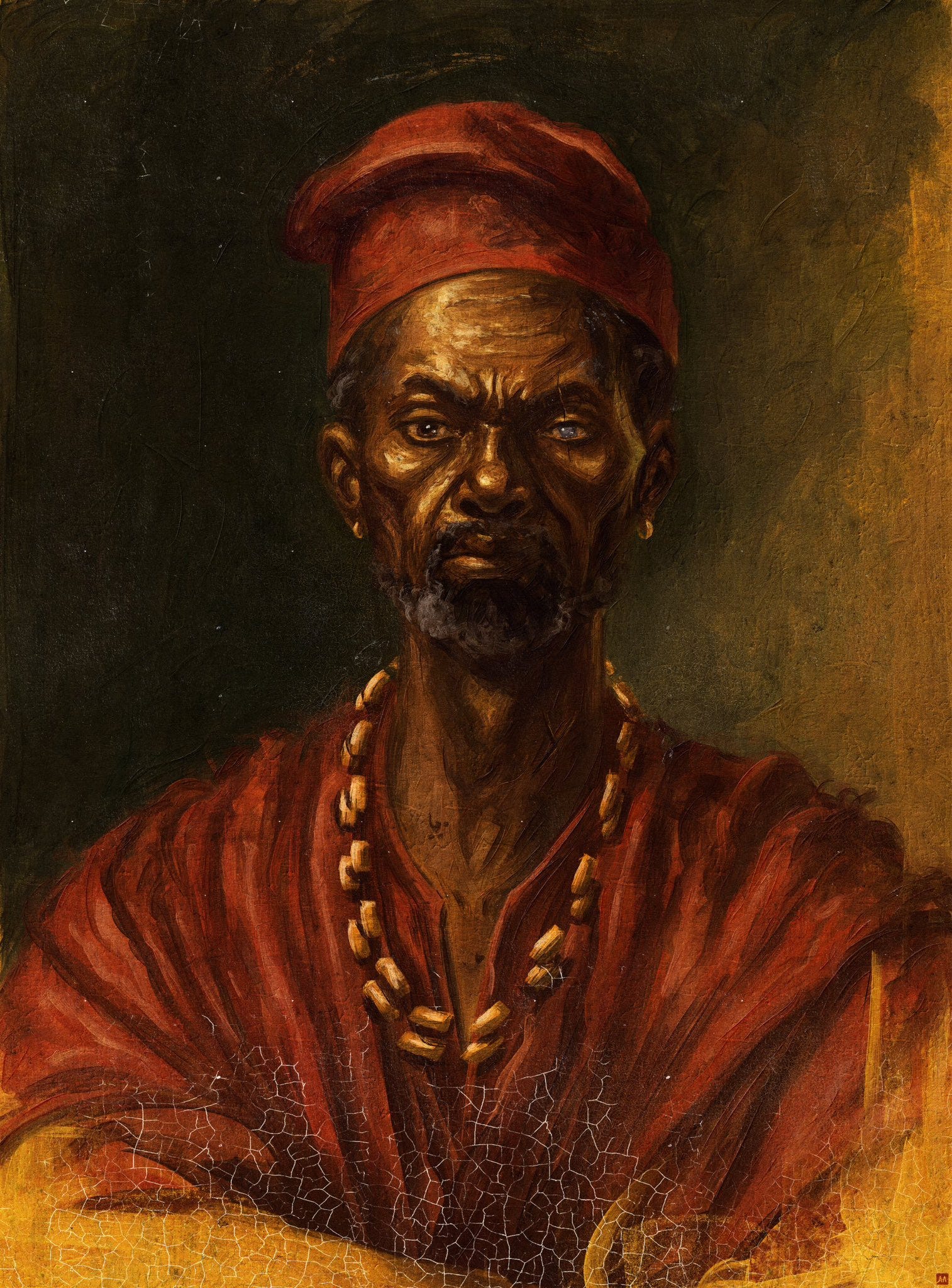
Baami Painted by Anthony Azekwoh
Hmmm... I wept too when my Papa left😥😥
Our slain soldiers deserved credits... not many of them grew old fighting insecurity in Nigeria!!
To your question, I believe, they go to the place where their tears shall be wiped away, a place of rest.
Nice Read